

Saturday, August 15, 2015
1 Mushroom Pepper Rice Noodle Bowl



This recipe is super quick and easy to make. Cooking is time is only 10 minutes total! Can we say "quick"?! :) These days, I'm really into no-brainer cooking, especially in summer, when it's important to keep the house as cool as possible; so the less time spent cooking, the better. If it can be whipped up in a few minutes, then, bring... it... on. Lol. Of course, you don't have to spend all day slaving over a hot stove to make something delicious. The below recipe is proof of that. :)
The dish has got everything you need in a bowl -- protein, carbs, healthy fats, and fiber. Plus, it's colorful, pretty to look at, and really tasty to boot! OK, enough blathering; on with the recipe!

Mushroom Pepper Rice Noodle Bowl
Ingredients:
1 Tbsp. sesame oil
1 Tbsp. peeled and finely minced garlic (2 large cloves)
1 Tbsp. peeled and finely minced ginger (1" piece)
1/2 tsp. salt
1/4 c. peeled and minced shallots
1/8 tsp. crushed red chili pepper flakes
1/4 c. Chinese rice cooking wine
2 Tbsp. low-sodium soy sauce
1 c. sliced mushrooms
1/2 c. diced red bell pepper
1/2 c. diced orange bell pepper
1/2 c. diced yellow bell pepper
1/2 c. diced green bell pepper
1/4 c. sliced almonds (or crushed peanuts)
1 Tbsp. sesame seeds
2 dried vermicelli (rice noodle) "cakes"
Directions: Place garlic, ginger, and salt into small ceramic mortar, and pound vigorously with the pestle until pulverized. (If you're feeling super-lazy or don't happen to have a mortar and pestle, just process it in the food processor instead.) Set it aside. Soak vermicelli noodles in a bowl of hot water for 3-5 minutes, until the noodles become soft and loose. When they're ready, drain and set aside.
As you're soaking the noodles, cook the vegetables: In a large (12-13"-diameter) sauté pan, heat sesame oil on high heat until glistening, then reduce heat to low and add garlic-ginger paste, shallots, and crushed red chili pepper flakes, and cook for 5 minutes, or until tender and (slightly) golden brown, stirring frequently. Deglaze with Chinese rice cooking wine and stir a bit to break up the fond (i.e., the brown caramelized bits at the bottom of the pan). Immediately add mushrooms and soy sauce, stir to combine, and cook for 5 minutes. Then add bell peppers, almonds (or peanuts), and sesame seeds, and cook for 5 minutes more, stirring occasionally. Vegetables should be tender but still somewhat firm and retain their color. Turn off heat and add rice noodles to pan, stirring well to combine all of the ingredients. Serve and enjoy!
Yield: 2 servings.


Monday, July 27, 2015
Asian-Style Swiss Chard Stir-Fry with Toasted Young Coconut

This recipe is yet another "Vegetable of the Week" Challenge recipe and is also part of Cooking with Corey's "Quick & Easy Healthy Meals" series. This is Week #3 of the challenge, and you're all welcome to join us. The Vegetable of the Week (VOTW) is of course, Swiss chard. To find out more details on how to participate in this fun and exciting challenge, please visit this link on this blog's Facebook page.
Asian-Style Swiss Chard Stir-Fry with Toasted Young Coconut
Ingredients:
1 1/2 Tbsp. sesame oil
1 Tbsp. garlic, peeled and finely minced
1 Tbsp. fresh ginger, peeled (with a spoon) and finely minced
1/8 tsp. crushed red chili peppers
1/2 c. scraped/shredded young coconut, thawed (from a frozen package, or fresh, if available)
4 c. densely packed, chopped Swiss chard
1/2 Tbsp. tamari sauce
1 Tbsp. sesame seeds
Directions: In a large (12-13"-diameter) sauté pan, heat sesame oil on high heat until glistening, then add garlic, ginger, crushed red chili pepper flakes, and young shredded coconut, and cook for 3 minutes, or until coconut turns golden brown, stirring frequently. Reduce heat to medium-low and immediately add Swiss chard, tamari sauce, and sesame seeds. Stir continuously and continue to cook for another 2-3 minutes, or until Swiss chard is tender but still retains its color. Serve and enjoy!
Yield: 2-4 servings as a side dish, and with a 3-4 oz. per person protein staple, 1-2 servings as a main course.
Chef's Notes: You can find scraped/shredded young coconut at an international market. (Or, if you have the time and the patience, you can take a fresh coconut and scrape it yourself. :) Yeah, probably easier just to buy the frozen package. Lol.) Please note, scraped/shredded young coconut is not the same thing as the sweetened shredded coconut that you see in the baking aisle of your local supermarket, nor is it the same as the dried, plain shredded kind. Young coconut is moist and has an altogether different consistency and flavor when cooked.
Thursday, March 26, 2015
Respiratory Remedies (& a Medicinal Tea Recipe to Follow)
 Last week, I started to feel a bit of a scratchy throat coming on. Shortly thereafter, that was followed by a cough and a cold, then fatigue, headaches, and all-over body aches. And of course, with flu season in full effect here, my first thought was, "Uh-oh, here it comes." I was bracing myself for what was probably the start of a respiratory infection. All the typical signs were there.
Also, due to the crazy back-and-forth weather we've been having here lately (Mother Nature can't make up her mind whether it's winter or spring!), it's no surprise that lots of people in this area have been getting sick. The weather here has just been insane. We got SNOW on the first day of spring. Yes, that's right. You heard me correctly. I said, "Snow." Mother Nature clearly has an ironic sense of humor. ;) As I joked earlier on Facebook, "This year, it's been more like, 'March comes in like a lion who then changes into a lamb costume, successfully infiltrates enemy lines, and then proceeds to eat the entire flock.' Hahaha."
And before that we had what felt like endless snow, and, not surprisingly, after a while, lots of people started cracking jokes about it, myself included. I posted: "If this snow doesn't start melting soon, I'm going to start putting up wanted posters that say, '$1000 reward for any information leading to the apprehension and arrest of Punxsutawney Phil. Wanted for criminal conspiracy with Mother Nature, in connection with the petty robbery of spring weather.' ;) First day of spring, my @$$!!!! Hmmmm. I wonder what groundhog meat tastes like?! ;) JUST kidding." :-D Yeah, we'd all pretty much had it, so when spring briefly peeked its head out from underneath the melting snow piles and finally gave us some lovely sunny 65 degree weather, many of us were so ecstatic about it that we went straight outside to celebrate. I know I certainly wasn't the only one who went outside to exercise that day. :-D
 And then it got cold again. And it snowed. And then people got sick. And then, well, you know the rest. :)
Since several of my friends were feeling absolutely miserable from flu, sinusitis, bronchitis, etc. (and the luckier ones escaped with only a slight cough &/or cold), I gave them some recommendations for things they could do or take to help them fight their respiratory illnesses, including fish oil pills and other supplements, medicinal teas, etc., and also sent one of my friends a TLC package filled with several of these flu-fighting 'goodies.' We both followed similar regimens (and so did her husband, who'd also gotten sick), and after a few days, we were all gradually starting to feel better (knock on wood!). I've also put together different variations of this regimen in the past, but this most recent combination of remedies seemed to work the best thus far. So, in order to help others who are trying to beat respiratory infections, I'm going to post that regimen here very shortly. As a legal disclaimer, please note that I am not suggesting that you following the below regimen, only that this is what I do because it works for me and some of my friends, and that, in any event, you should always consult a physician before following any new health regimen.
 Since I'm in the business of helping people get (and stay!) healthy, not surprisingly, I spend a LOT of time reading about nutrition, exercise, and general health related topics in general, immersing myself in medical science journals, white papers, clinical study reports, and other source materials. My job, as I see it, is not only to distill this information so that it's of optimal use to others, but also to show people how to apply it to their daily lives in the most realistic, effective way possible. And likewise, that was one of my primary goals in writing The Athlete's Cookbook, to write a practical, succinct, action-oriented book that shows people how to use food in very specific, scientifically sound ways to improve their athletic performance. Simply put, I applied my knowledge of the biochemistry of food to help people achieve three different goals -- endurance, strength, and fat-burning. Each goal has its own distinct program, complete with corresponding nutritional overviews, meal plans, recommended food lists (Top 10 Healthiest Fats/Carbs/Proteins/Fat-Burning Foods, etc.), eating and workout schedules, and recipes. The book provides a straightforward framework that's uncomplicated and easy to follow, one that doesn't require any prior knowledge of cooking or food. Every recommended nutritious food I list in the book has a matching recipe that seamlessly plugs into the appropriate corresponding nutritional program(s). And since I created the nutritional programs and the recipes with busy athletes in mind, the book contains quick and easy, delicious recipes with easy-to-find common ingredients. Everyone's so busy these days, and athletes still need to train for multiple hours on top of that, so it was essential to keep things simple and quick.
With regard to the above approach to nutrition, exercise, and general wellness issues, I employ similar methods when it comes to helping loved ones who are feeling under the weather: I read all of the source material from the scientific and medical establishment that I can get my hands on, and if I read general articles on these topics, I do my fact-checking to make sure that this information is up-to-date and comes from reputable sources. Then, I base my "plan of attack" on the most useful and relevant information I've gathered. And if new scientific evidence from reputable sources comes along, I'll research it thoroughly and then, after evaluating its usefulness and applicability as a solution to a specific issue, will consider altering my plan to incorporate these new findings. Since scientists are constantly making new and exciting discoveries, prevailing scientific wisdom can change a lot in light of new evidence gleaned from these discoveries, and so it's important to stay current with all of these scientific breakthroughs and remain flexible and open to new evidence from reputable sources.
So, given the above, what I offer below is an overview of the respiratory infection regimen that has worked for me and others, a compilation of remedies based on current scientific findings:
- 3000 mg (3 g) fish oil pills. Look for burpless, purified fish oil capsules that contain at least 1 g of EPA and DHA combined (per serving). (It's very important to take the purified kind, since unpurified fish oil can contain undesirable, i.e., toxic, levels of mercury.) Please be aware that, in general, recommended daily dosages can range anywhere from 500 mg to 3000 mg (3 g), depending upon a variety of factors (individual's age/weight/body chemistry, whether it's for a specific use, i.e., treatment for a condition, vs. general usage, and the recommending body, i.e., specific medical organization/professional, etc.), so it's always a good idea to consult a doctor first to determine the exact dosage that is appropriate for you. Case in point: I take 4000 mg but again, this dosage has been specifically prescribed for me by a licensed, board-certified physician. In fact, you should consult a doctor if you are thinking about taking any more than 3000 mg. Too much fish oil, like almost anything else, can be harmful (i.e., it can actually increase the risk of stroke, etc.). So, in other words, 3000 mg is generally considered safe for most individuals, so that's why I'm not listing any more than that here. This is what I would recommend to a friend who's trying to fight a respiratory infection, but again, to protect my hide, I'm going to advise you to first consult a physician, regardless of what I list here. :)
The Omega 3s in fish oil pills (and other Omega-3 rich foods) really help to ramp up your immune system. According to a study conducted by Britain's Institute of Human Nutrition and School of Medicine, Omega 3s increase the activity of phagocytes, i.e., cells that protect the body from infection by eating harmful foreign particles, bacteria, and dead or dying cells. There's also research showing that Omega 3s increase airflow and protect lungs from colds and respiratory infections. [Sources: Cell (research journal) (7/3/13), Cell (3/28/13), Nature (scientific journal) (3/7/13. Prevention (12/12/13); Daily Mail (3/8/13), Everyday Health (3/8/13).]
(If you can't take fish oil for some reason, microalgae oil supplements are a decent vegetarian alternative, since their Omega-3 fatty acid composition is very similar to that of fish oil and it's also got a low risk of pollutant exposure.)
- Protein. Protein keeps your immune system strong, so make sure you are eating enough protein, especially when your immunity is compromised. And while you're at it, you can get both Omega-3s and protein by eating oily high-protein fishes such as salmon, mackerel, sardines, herring, tuna, etc. Try to eat fish twice a week. [Sources: PubMed, ScienceDaily. Further reading: SFGate.]
- Multivitamins. Multivitamins cover a lot of bases. Preferably choose one that meets the RDA for the specific vitamins and minerals that play a key role in immune system function (i.e., vitamin A, B-complex vitamins, vitamin D, vitamin E, selenium, etc.) There's still some debate as to whether or not zinc and vitamin C actually boost immunity. As for herbal supplements, there's a lot of disagreement on efficacy. For example, the verdict's still out on echinacea as to whether or not it has any effect upon colds. Some in the medical science community say it works, while other say it's hype. Same goes for astragalus, ginseng, etc.
It's great if you can get a lot of these vitamins and minerals from fresh healthy foods, but taking a multivitamin will ensure that you cover all your bases. It's also a practical choice, i.e., so won't have to eat 500 lbs. of kale just to meet multiple RDA requirements for various vitamins and minerals (Lol!). For example, while one cup of kale meets and exceeds the RDA for vitamin A (133%) and vitamin C (134%), you'd have to eat an awful lot of kale to meet the RDA for calcium (1 cup = 10% RDA), vitamin B-6 (1 cup = 10% RDA), magnesium (1 cup = 7% RDA), and iron (1 cup = 5% RDA). Of course, you could eat different types of foods to cover those other bases, but then you'd have to map out your daily food intake by nutrient, and then calculate how much you'd have to eat to meet each RDA. And on top of that, there are other considerations like portion sizes, daily fluid intake as well as daily RDA (and ratio) of the different kinds of essential proteins, carbs, and fats. Even if you spend the time to calculate everything and create your own meal plans -- or hire a nutritionist to figure everything out for you, there will obviously be times when you're going to veer off course from your menu plan, due to personal whims or unforeseen circumstances. So, that's yet another reason to hedge your bets with a multivitamin. It's just extra insurance. :)
- Make lifestyle improvements to boost immunity. For example, take steps to reduce stress, eat healthy food, try to get 8 hours of sleep, drink lots of liquids (even more than usual when you are sick), frequently wash your hands with antibacterial soap (&/or use hand sanitizer), take the necessary time to rest so you can recover more quickly and regain your energy while you are coping with the fatigue associated with flu, exercise regularly but be careful not to overtrain, etc. If you're not feeling overly rundown, provided the infection hasn't already traveled to your chest, even a short 30-minute walk can boost your immunity. However, if you're already in the thick of a serious respiratory illness (chest cold, productive chest cough, body aches, etc.), it's best to take a break from exercise and get adequate rest so you don't weaken your already compromised immune system. In that scenario, exercise usually does more harm than good. The body needs rest at this stage. As a running coach, I advocate the "neck rule": So if you have symptoms occurring above the neck (stuffiness, cold, sneezing, etc.), it's typically fine to exercise, but if it's anything below the neck (bronchitis, chest cold/cough, body aches, etc.), then you definitely need to take some time off from exercise and rest. Anything more than a minor cold and it can quickly escalate into a more serious situation impacting your lower respiratory tract and lungs. As the saying goes, "If it's in the chest, rest."
- Medicinal teas. For starters, if you go to the tag cloud on the right sidebar of this blog and click on the herbal tea tag, you'll find several homemade medicinal teas that I use in conjunction with some of the above-described remedies to beat various respiratory ailments. On a related note, up next is my newest medicinal tea recipe, "TLC" Tea, which I'll post in a bit.
The above regimen is by no means an exhaustive list. In any case, my first course of action is to try to beat respiratory illness symptoms early on, by natural means whenever possible, as the over-reliance on antibiotics and other drugs can lower your resistance to them, not to mention that the repeat usage of antibiotics contributes to national/global antibiotic resistance, which is a serious public health concern. That being said, of course, if one's condition doesn't improve, it's best not to wait too much longer to see a doctor and get a prescription for the appropriate medication (like a Z-pack or other medicine). Typically, the earlier you hop on a respiratory issue and throw your entire arsenal at it (including what's in your cupboards and fridge!), the easier it is to get rid of it.
Hope these tips will help you stay well, so you can enjoy the lovely spring weather we're having today. It's 70 degrees here!! Time to go outside and enjoy it. :-D
Thursday, April 17, 2014
Freezer Bags: An Effective & Compact Way to Store & Organize Frozen Food
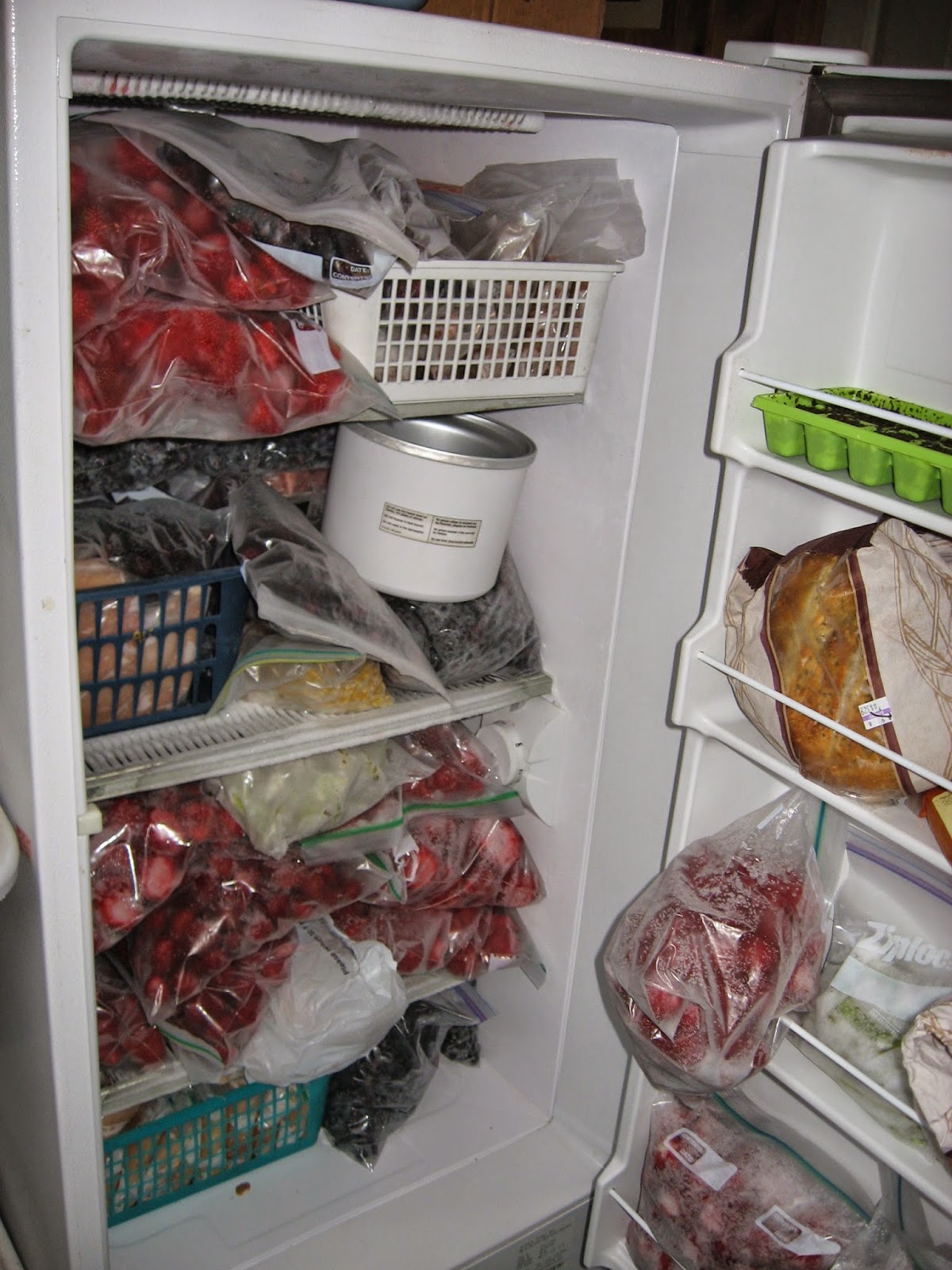 While it's certainly preferable to eat homemade meals that've been freshly made, we all have those days when we'd rather just defrost something than cook. :) Basically this translates into, "Food, please magically appear. NOW." Hahaha. After all, defrosting food is not exactly labor-intensive. :)
If you're like me, and like to freeze homemade meals you've pre-prepared for a future date, you'll probably need to make the most of every inch of valuable real estate in your freezer. I don't know about you, but until I found a better system for frozen food storage, my freezer would frequently run out of space. I'd try to squeeze in the very last container, which would never quite fit. Of course, this would drive me nuts, because then I'd have to remove everything and rearrange stuff just so that ONE item could fit. :)

Or, here's the other scenario: After beaming with pride and self-satisfaction that I'd manage to fit every single item into the freezer without an iota of wasted space, I was faced with the following realization: "What if I needed to actually remove something from the freezer?" Hahaha. Yes, it appeared that my little inner "happy dance" was a bit premature. :) I'd pack the items into the freezer so perfectly, like a tightly fitting 3D jigsaw puzzle, that any future attempts to extract the single precarious, load-bearing container that was propping up everything else -- you know, the one and only container I needed to defrost for dinner that night -- was just asking for it. :) The next time I needed to remove something, I'd probably need to call in for backup. ;) One wrong move and "BAM!" At any moment, that little game of "food Jenga" could turn into a rushing avalanche of heavy frozen plastic food containers that'd come crashing down on my head, or worse, my toes. And let me tell you, nothing hurts more than a frozen food crash landing onto your toes or other delicate body part (OW!), not that I'd know anything about that. :)
Even if you have uniform-sized containers, it can sometimes be tricky to fit items into your fridge. After all, chances are pretty good that whoever designed the freezer section of your fridge hadn't taken the exact dimensions of your frozen food containers into consideration. :) There's always going to be that one last container that won't perfectly into the end of a row. Then, what are you going to do? :) If you're packing a lot of food in there, you need to make the most of that space, and those awkward shaped holes aren't helping any.
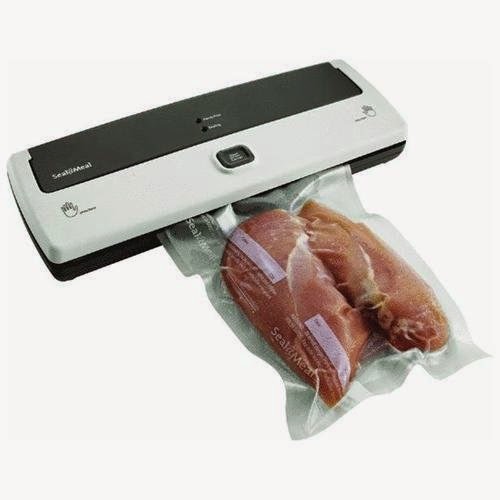 OK, I know there are those heat-activated, vacuum-sealed contraptions that require custom bags specifically designed to fit the thing, but since the seal is permanent, they're a pain-in the neck anytime you want to easily reseal your food, which, if you're like most people, can be fairly often. As a testament to how convenient they are to use, I think my mother probably still has hers tucked away in the back of a cupboard somewhere, but I don't think it's seen the light of day in a LONG time. :) (Seriously, that thing is ancient! Hahaha.) Plus, if you run out of those specialty bags when you're in a pinch, good luck trying to find a place where you can quickly get some replacement bags. No thank you. :) I'd rather use something a bit more commonplace and easier to find and use.
The other issue is freezer burn. I've even used those supposedly air-tight, lock-top containers and then bagged them in plastic freezer bags on top of that and it doesn't seem to make much of a difference; they STILL get freezer burn. Even if you remove all of the air from the plastic bag, there's still the container itself, which you have to fill to the rim to get rid of the air, and even then, there are no guarantees. Of course, no one likes having to throw away items covered in freezer burn. Not only is it wasteful, but it's not exactly pleasant when you're handling the affected food, which smells (and tastes!) rather nasty. Yes, I've tried to salvage freezer burned food before because I can't stand wasting food, and the results were almost always disastrous. It can be a very frustrating experience, because even if you think you've gotten rid of all those pesky air pockets, the freezer burn beastie can still attack your frozen food. The fact remains -- those plastic containers just don't cut it when it comes to freezing food.
Do the above experiences sound familiar to you? If so, fear not. I have the perfect solution. :) For those of you who are trying to figure out a way to maximize and better organize the space in your freezer, here's a simple but effective idea: Instead of using plastic containers to store leftovers, which are bulky and leave food more susceptible to freezer burn, use freezer bags. They take up far less space, are easier to fit into your fridge, and can be used for storing almost any kind of food -- fruits and veg, soups, sauces, chilis, etc.
(1) For the best results, wait until cooked food cools completely (you don't want toxic chemicals from
melted/heated plastic bags to seep into your food), then pour the food into a plastic freezer bag. Press out as much of the air as possible (make sure you squeeze out every last air bubble!) and then double bag your items, both of which will help prevent freezer burn. If you do this, your frozen items will remain usable for a pretty long time. Take it from me: Some of the items in my freezer just might've been left over from the Ice Age, but nonetheless, I've managed to pull them out intact and unscathed. :)
 (2) To save the most space, first stack them horizontally like pallets in your freezer and uniformly flatten each one with your hands (or a metal tray) before stacking the next one on top. Once they are frozen, they're much easier to "re-file" vertically, which I've found to be the easiest way to access them, unless you're storing them on freezer shelves that consist of wire racks. In that case, horizontal storage works best, especially for some of the thinner items, since this way, the bags won't accidentally slip through the slats. :)
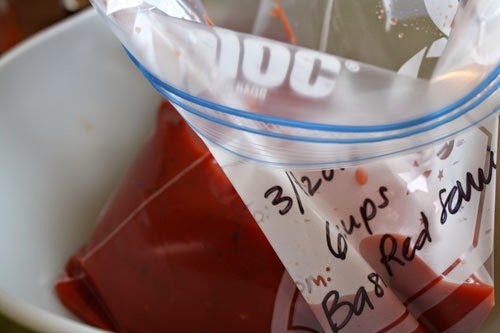 (3) Also, it's a good idea to mark the outer bag first with a description and date of your food BEFORE you fill the bags with food. ;) Even if you use permanent marker, like I do, it's harder to write on them once the food's inside, not to mention that the marker tends to rub off that way, due to the inevitable condensation that occurs after you transfer the food to the bags.
(4) Make sure the bags you use are actually freezer bags and not plastic sandwich bags, which don't protect against freezer burn. Also, I've found that the double zipper kind -- and not the kind with the "sliding" zips (!) -- are the best for preventing freezer burn, because they provide the tightest seal possible.
(5) Even though some items already come wrapped in plastic (like poultry, hamburger meat, etc.), it's still a good idea to put them in freezer bags, because they'll keep better that way in the freezer. With only the plastic wrapping, they're still susceptible to freezer burn, because the plastic packaging is way too thin and wasn't intended to be freezer burn proof.
 |
| Ziploc® brand Double Guard® Freezer Bags |
There's nothing like a bit of organizing to cleanse the soul and put your mind at ease. If nothing else in your life is under control, then at least there will be order in this one small space of the universe. :) And if a sense of calm doesn't wash over you, then maybe you need to organize the rest of your kitchen. Hahaha.
Tuesday, December 3, 2013
Avocado-Pesto Dip

This effortless, flavorful dip recipe combines two of my favorite ingredients -- avocado and pesto. I came up with the idea yesterday afternoon when putting together dishes for our weekly menu. I'd just finished prepping the vegetable side dish for that night's dinner, i.e., Pesto Pattypan Squash and Baby Zucchini (recipe forthcoming), and so the pesto was still lying out on the countertop. Just as I was about to put the pesto away, I swiveled around to grab it and my eyes happened to land on a lonely avocado not but a few feet away in the opposite corner of the kitchen. Of course, that's when the idea dawned on me to combine the two ingredients. :) Since we'd just had the squash last night, we'll be saving the dip for later this afternoon. No one in my family's complaining though; right after we'd finished last night's dinner, my sister found out about the avocado-pesto dip and said, "How soon can we eat THAT?" Hahaha. Too much pesto? Apparently, in our family, there's no such thing. ;)

Avocado-Pesto Dip
Ingredients:
1/2 ripe Haas avocado, peeled and pitted (makes about 1/2 c. mashed)
1/4 c. pesto (see recipe)
1 Tbsp. freshly squeezed lemon juice
2 Tbsp. Italian flat-leaf parsley, finely minced and tightly packed
1/2 Tbsp. garlic, peeled and finely minced
1/8 tsp. ground black pepper
Directions: Mash avocado in a medium-sized bowl but leave it a little bit chunky to give it some texture. Add all remaining ingredients to the bowl and mash everything together until just combined. (Or, if you'd like to take the ultimate shortcut, then don't bother chopping up any of the produce; just peel the garlic and peel and pit the avocado, then toss everything into the food processor and pulse until just combined.) Serve with crudités or other accompaniments and enjoy!
Yield: 1 c.
Thursday, November 21, 2013
Don't Know What to Serve with the Bird? Here are Some Thanksgiving Dinner Menu Ideas....
 Yes, it's that time of year again, when many of us start thinking about what we're going to serve for our
Thanksgiving Day dinners. Some will take the traditional route, while others will toss in some unexpected choices. Whether you're still scratching your heads or just need a few dishes to round out your meal, I'm here to help you with your menu planning by providing you with suggestions to suit a wide variety of needs. Plus, if you're serving an army, it's typically a good idea to offer several different appetizers, sides, and desserts to keep everyone happy and well fed. Below, you'll find a comprehensive array of choices from all of these different dish categories. The only thing that's missing is the bird. :) However, it's usually the other stuff (i.e., everything else!) that people have more of a challenge figuring out, so this extensive list should give you more than enough meal ideas to get you started with your menu planning.
As a chef and frequent host, I've planned lots (and I do mean LOTS!) of menus for dinner parties and large gatherings in the past, and have also helped family and friends with this as well. In fact, for one of our previous Thanksgiving Day gatherings (from a year or two ago), I helped my aunt draw up a menu and calculate food amounts for her guests. If memory serves, they had over 20 people at their house that year, along with three very large hungry poodles, one of whom suddenly decided to jump up on the table after dinner to help clean up the scraps. :)
We really went all out that year: One family friend made a sweet potato dish, my aunt made the turkey, some salads, and vegetable side dishes while I "filled in the blanks" with pumpkin soup, cranberry sauce, two pumpkin pies, and a fruit tart. Everyone's dishes were homemade, so although it was a lot of work (and several days worth of kitchen prep and cooking!), it was lots of fun to make everything. Despite the chaos that sometimes surrounds the process, the end result is usually well worth it, because Thanksgiving is a time when the food and conversation will (hopefully!) bring everyone together and provide a happy background for friends and family to relax and more fully appreciate each other's company.
Anyhow, enough verbiage. I hope you'll find the below meal ideas useful to keep your menu fresh and exciting. Have fun cooking (and eating!), and I wish you all a Happy, Healthy Thanksgiving!
-C

Traditional Selections (Updated & Revamped):
Appetizers:
- Pumpkin-Potato Soup with Fresh Sage, Rosemary, & Basil: This one was a huge hit at one of my aunt's previous Thanksgiving dinners. Even Erik ate it, and he doesn't typically even like pumpkin soup. :) My friend Charlie's also made it and told me his family liked it a lot as well.

- Antipasto: Well, it's considered to be a traditional fall holiday appetizer if you've got Italian relatives. :) Erik's family will typically serve this at their Christmas dinner, so since these two fall holiday meals are often very similar in nature, it'll surely work for Thanksgiving dinner as well. My version, Italian-Style Marinated Vegetable Salad (Antipasto), still contains all of the traditional elements but, unlike the plated variety, combines them into an easy-to-eat form that fits onto crackers. Just provide a serving spoon and some crackers or bread for your guests, and you're all set. Or, if you'd rather stay away from (or limit) the starch component, cut up crudités for your guests, like cucumber rounds, etc., which can serve a similar purpose.
- Hors d'Oeuvres: It's a good idea to give your guests something to munch on before the meal starts: This is done just as much to stave off hunger as it is to keep curious guests from wandering into the kitchen before meal time and nibbling on dishes for an "advance preview." We all know people who like to break off bits of our unfinished dishes to sample things before they before they are really supposed to be doing that. ;) So, keep them at bay by offering them finger food like Mushrooms Canapés Stuffed With Goat Cheese, Kalamata Olives, & Fresh Herbs or various types of dips served with crudités, chips, &/or crackers. On that note, check out the wide selection of dips on this site as well -- from freshly made guac, hummus, and pinto bean dip to Caponata Siciliana, Creamy Red Hot Pepper Dip, and Tuna à La Tapenade.
Sides:
- Cranberry Sauce: To liven things up a bit, try my Cranberry Sauce Spiked with Cointreau. Think of this as "cranberry sauce for adults." Actually, most of the alcohol evaporates during the cooking process, leaving behind just a hint of Cointreau flavor for an extra special kick to the taste buds. So, really, it's perfectly suitable to serve to the kiddies as well. I assure you, unless you just pour in the Cointreau at the end instead of cooking it, or drink it while you're making it, absolutely no one will get inebriated from consuming this dish. :)
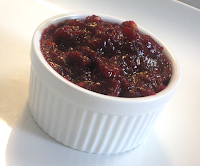
- Mashed Potatoes: Typically a popular choice at holiday gatherings, this side is sure to please and always goes well with the bird. If you'd like to stay traditional, go with Mashed Red-Skinned Potatoes with Roasted Garlic & Fresh Herbs or for the Irish(wo)man in you, try my Colcannon instead. :)
- Au Gratin Casseroles: Try Cauliflower & Orange Bell Peppers Au Gratin or Potatoes & Butternut Squash Au Gratin. These dishes are real people pleasers. I've served both in the past, and dinner guests frequently request the recipes, both during and after the meal. :)
- Pasta & Potato Salads: Marinated salads are yet another holiday staple, and there are so many different offerings from which to choose! For example, you could try Tomato & Goat Cheese Pasta Salad with Fresh Dill & Tarragon, Greco-Roman Pasta Salad, or even a cold pesto pasta salad using a recipe for fresh basil pesto with walnuts and almonds, or go with something like Fennel-Potato Salad instead, which is a nice change from the plain version. This potato salad is very light and will allow you to leave room for all of the other selections on the Thanksgiving table that you'd like to try. :)

- Green Vegetable Side Dishes: Broccoli, in particular, is a good selection because it works with almost any traditional holiday entrée, including poultry. Try a simple and versatile version of this dish like Italian-Style Sautéed Broccoli with Fresh Herbs. Or go with Wilted Spinach or Quick & Easy Italian-Style Beet Greens instead.
- Carrot Dishes: These seem to be pretty stock and trade for Thanksgiving at many people's homes. Try my Grilled Carrots or Ginger-Garlic Baby Carrots.
- Sweet Potatoes: Sweet potatoes are another traditional holiday selection. Instead of making sweet potato mash the sweet way (i.e., with marshmallows, etc.), shake things up a bit and offer a savory (and much healthier!) preparation in another form, like Swoon-worthy Sweet Potatoes. This dish is super-easy to make, and best of all, you don't need to spend all that extra time stirring and mashing. :)

- Rosemary Potatoes: Another holiday standard, or at least it is in our family. :) Need a recipe? Try my Rockin' Rosemary Potatoes.
- Rice Pilaf: You can either do a fairly plain and neutral tasting pilaf like Herbed Bulghur Pilaf or a standard mushroom pilaf like Mushroom Rice Pilaf with Fresh Herbs.
- Pumpkin Pie: For Thanksgiving dinner, it doesn't get much more traditional than good ole' pumpkin pie. This is a non-dairy version for people who are Paleo, vegan, or kosher. It's also gluten-free. For the Paleo version, substitute almond flour for the oat flour and if you're strict Paleo, look for another viscous binding agent (perhaps maple syrup?) to replace the honey. This recipe is one of my most requested holiday dishes. :)

- Tiramisù: Again, if you've got Italian relatives, this one is pretty standard fall holiday fare as well. My own version, Tantalizingly Transcendent Tiramisù, uses both ricotta and mascarpone for a lighter (and far less fattening) flavor, while still remaining incredibly rich and indulgent tasting. This way your taste buds can revel in dessert-esque ecstasy without you having to loosen a few notches on your belt buckle after the meal. ;)
Novelty Dishes:
Appetizers:
- Elegant But Simple Salads: For example, try Cucumber, Tomato, & Artichoke Salad: So easy (only three basic ingredients!), it can be made in a snap! Or, for an elegant touch, make Baby Rocket, Chickpea, & Hearts of Palm Salad with Shaved Manchego Cheese, Tossed in a Lemon-Mint Vinaigrette -- You could probably finish making that salad by the time it takes to read the recipe name. Lol. When you've already got enough labor-intensive (and time-consuming) tasks like turkey prep and cleaning your house before the arrival of your guests, simple salads like these (and other no-brainer selections!) can be a huge timesaver, not to mention a lifesaver too. :)

- Hearty Soups: These are the types of wintry/fall soups that would nicely complement a Thanksgiving Day meal. Particular suggestions that come to mind include Mushroom Barley Soup, Kale-Potato-Leek Soup, Potage Provençal aux Légumes Verts (Provençal Greens Soup), Corey's Cream of Broccoli, or "Potatoes in Paradise" Potato Soup. Or try a bean-based soup like Italian-Style Two-Bean Soup or Tomato-Zucchini Soup with Kale, Yellow Squash, & Cannellini Beans (Topped with Parmesan Cheese & Pesto Drizzle).

Sides:
- Celeriac Remoulade: This dish is very similar to coleslaw, but with a sophisticated twist. It's a neat idea if you're looking for a menu update to keep things interesting. :)
- Cauliflower Mash with Rosemary & Roasted Garlic: This dish is a nice (and much healthier!) alternative to mashed potatoes. Plus, it's really tasty too! It also makes a great selection for guests with particular dietary restrictions -- it's Paleo, vegan, and gluten-free. :) Whoopeeeeee! Hahaha.
- Pumpkin Risotto: Still in keeping with the pumpkin holiday theme and yet, it adds an element of surprise. This could also be served as a vegetarian (or vegan) main course as well.
- Mushroom-Olive Quinoa Pilaf with Fresh Herbs: Instead of the usual rice pilaf accompaniment, try this dish to add some interest and round out your menu.
- Lavender-Infused Potatoes with Garlic & Fennel: Highly aromatic and unexpected, this dish is a bit more creative and sophisticated than your average potato dish.
Desserts:
- Cherry, Apple, & Pear Tart (Made with Asian & Bosc Pears): This one's another big Thanksgiving dinner hit. It's also a nice alternative to pumpkin pie.
.png)
- Poached Persimmons: Delicious and appropriately seasonal, this dish has a taste that's both tart and sweet. Be sure to allow these fall fruits enough time to blet in order to reach the full peak of their flavor.
- Baked Figs (or Pears): Another seasonal selection, this dish is soaked in Marsala wine, which makes them taste even better. :)
- Apple Tart: Simple but decorative, this version of apple tart is healthy and delicious!
Wednesday, November 20, 2013
3 Tomato-Zucchini Soup with Kale, Yellow Squash, & Cannellini Beans (Topped with Parmesan Cheese & Pesto Drizzle)

First of all, congratulations to the two very knowledgable winners of the Fall Fun Contest! Your pumpkin and squash expertise is truly impressive! Hope everyone had fun with the contest. It seems that a lot of you did, since you gave me lots of positive feedback about it. So, because it was such a smashing success, I might hold another one next year, with new and different types of squash and pumpkins for you to identify, but of course. And who knows, maybe I'll even toss in a few edible gourds or two to make it even more challenging. :)
But really, it was about time to climb back onto the horse again. So here I am again, back in action after 2 1/2 months, in case you were wondering if I was ever going to post another recipe here ever again. ;)

Tomato-Zucchini Soup with Kale, Yellow Squash, & Cannellini Beans (Topped with Parmesan Cheese & Pesto Drizzle)
Ingredients:
1 Tbsp. extra virgin olive oil
1/4 c. shallots, peeled and finely minced
1 Tbsp. garlic, peeled and finely minced
4 c. vegetable stock, divided
2 c. fresh kale leaves, stems and ribs removed
2 c. zucchini, diced (about 1 large or 2 medium zucchini)
2 c. yellow squash (about 1 large or 2 medium yellow squash)
2 c. vine-ripened tomato, diced
15.5 oz. can cannellini beans
4 c. water
8 Tbsp. tomato paste
1/4 tsp. ground black pepper
1/4 tsp. salt
1/4 c. fresh basil, roughly chopped
1 Tbsp. fresh thyme leaves
Toppings:
shredded Parmesan cheese, about 1 Tbsp. per serving
pesto, about 1 tsp. (or more) per serving
Yield: 6-8 servings.
